


 Aiden Kowalczyk
Reviewed by
 Elena Rasmussen
Four families of payment method
The cashier at a typical operator lists a dozen or more options, but they fall into four families: cards, e-wallets, bank transfer in its various forms, and crypto. Within each family the behaviour is broadly similar, and the differences between families are what you should understand before choosing. This guide compares them across the four things that matter: how quickly money moves in each direction, what it costs, what the limits are and what protection you have if a payment goes wrong.
Everything below comes from our own testing across the operators on this site between September and October 2026. Fees and limits vary by operator and change often; we give the ranges we saw and link to each operator’s payments page in its review.
The comparison
The matrix below summarises each method family across the operators we list. Deposit speed is instant for every method at every operator we tested, so the first column is mostly there to confirm it. The withdrawal column is the one to read carefully: it shows the range of times we measured from request to funds visible.
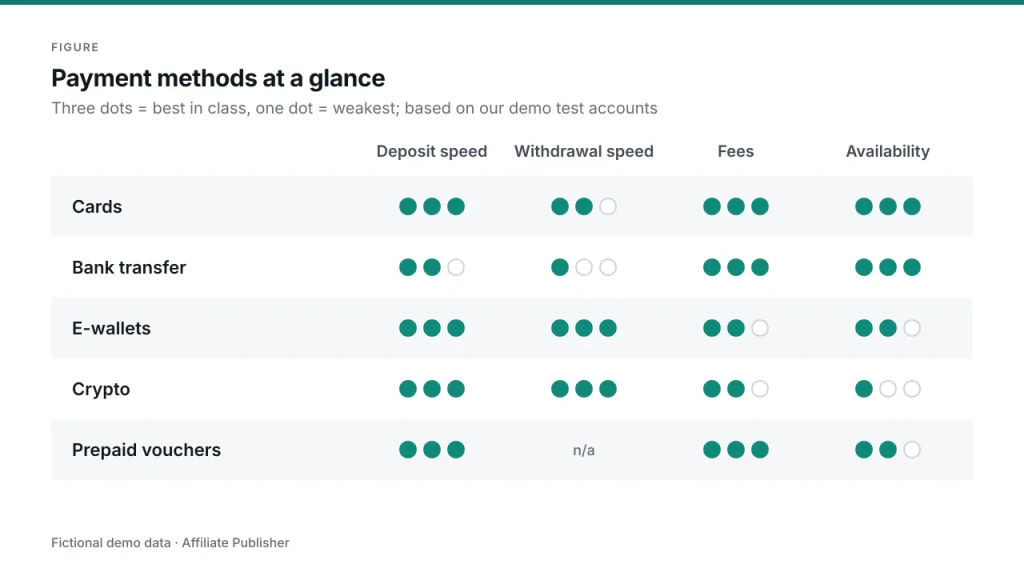
E-wallets were the most consistent performers, landing between two and eight hours after approval at every operator that supports them. Crypto was the fastest where available, with ApexBet and Solstice both paying in under an hour. Card withdrawals ranged from ninety minutes at NovaBet, which uses a push-to-card service, to three working days at operators that process card refunds through the conventional route. Bank transfers were slowest and most variable, from same-day at Vertex to two days at PrimeLuck.
Cards
Debit cards are the default for most players and are accepted everywhere on our list. Deposits are instant and usually free. Withdrawals depend entirely on whether the operator supports push-to-card: if it does, funds can arrive in hours; if not, the withdrawal is processed as a refund and can take several working days, during which your bank may show nothing at all. Ask support which route the operator uses before your first card withdrawal. It is the single biggest factor in card withdrawal speed.
Cards carry the strongest consumer protection of the four families. If an operator takes a payment it should not have, your card issuer has a dispute process. That protection does not extend to losses from play, only to payments that were unauthorised or not delivered.
E-wallets
E-wallets sit between your bank and the operator. Deposits are instant, withdrawals are fast because the wallet credits as soon as the operator approves, and the operator never sees your bank details. The costs are a small fee at some operators for e-wallet deposits, a possible fee from the wallet itself for moving funds back to your bank, and the fact that e-wallet deposits are frequently excluded from welcome bonuses. Check the bonus terms before depositing by e-wallet if a bonus matters to you.
Protection is weaker than cards. The wallet provider has its own complaints process, but there is no equivalent of a card dispute for payments to a gambling operator.
Bank transfer and open banking
Conventional bank transfer is the slowest method in both directions but has the highest limits, which is why high-stake players and operators like Vertex favour it. Open banking services (Trustly in our fictional catalogue) have changed the picture considerably: deposits are instant, there is no card involved and withdrawals at operators that support them arrived in two to four hours in our tests. Altura’s Trustly withdrawals were among the fastest non-crypto payouts we measured.
Bank transfers carry solid protection through your bank’s own dispute process, and open banking payments are covered by the same rules. Fees are usually nil for deposits; some operators charge for outbound wires below a threshold.
Crypto
Crypto deposits and withdrawals are the fastest of the four families once the operator approves, with no bank or card network involved. The trade-offs are covered in detail in our crypto outlook piece: price volatility if the balance is held in a volatile asset, the irreversibility of a payment sent to the wrong address and, at many crypto-first operators, a thinner licence. Network fees apply to every transaction and can be significant on congested chains.
Protection is the weakest of the four. There is no issuer, no bank and no dispute process beyond the operator and the regulator. Use crypto for its speed if you understand that, and keep balances low.
Choosing a method
If you want the strongest protection, use a debit card or open banking. If you want the fastest withdrawals, use an e-wallet or, where you are comfortable with the risks, crypto. In every case, use the same method for deposit and withdrawal where the operator allows it, verify the method on your account before you need to withdraw, and read the bonus terms for method exclusions before depositing. Whatever you choose, set a deposit limit first. The convenience of an instant deposit is exactly why.
Frequently asked questions
Why must I withdraw to the method I deposited with?
Anti-money-laundering rules require operators to return funds by the route they arrived. Most allow a different method only once the deposit method has been refunded in full.
Are e-wallet deposits really excluded from bonuses?
Often, yes. It is a common clause because e-wallet deposits are harder for operators to tie to a verified identity. Check the terms of the specific bonus.
Do operators charge for withdrawals?
Some charge for bank wires below a threshold or for more than a set number of withdrawals per month. Every operator review on this site lists the fees we encountered.
Sources
- Online gambling payments benchmark 2026 (Example Research Institute)
- Orbit Casino payment methods page (Orbit Casino (fictional))
- Altura payments and limits (Altura (fictional))
Sources & references
-
First-party editorial test of Altura — EV-2026-0004 (Oct 2026)First-party editorial testing
-
First-party editorial test of Solstice — EV-2026-0005 (Oct 2026)First-party editorial testing
-
Industry report
-
Original documentation
Spotted an inaccuracy? Tell us — we publish corrections publicly.
About the author

Aiden Kowalczyk
Aiden times deposits and withdrawals across card, e-wallet, bank and crypto rails, and writes about verification, payment limits and the practical risks of crypto-native platforms.


