
 Priya Nair
Reviewed by
 Elena Rasmussen
Why the licence is the first thing we check
Before a single game is loaded or a single deposit made, we look up the operator on the public register of the regulator it claims to hold a licence from. The licence determines almost everything that happens if something goes wrong: whether your funds are held separately from the operator’s own money, whether there is a complaints body you can escalate to, and whether the games have been tested by someone other than the people selling them.
The two regulators that come up most often among the operators we review are the Example Gaming Authority (EGA) and the Example Gambling Commission (EGC). Both are fictional, as is everything on this demo site, but the comparison illustrates the kind of questions worth asking about any real regulator.
Side by side
The table below compares the two regimes across the areas that matter most to players: fund protection, dispute resolution, game testing, bonus rules, marketing restrictions and affordability checks. Green cells indicate a requirement that is both mandatory and actively enforced; amber indicates a requirement that exists but relies on self-reporting.
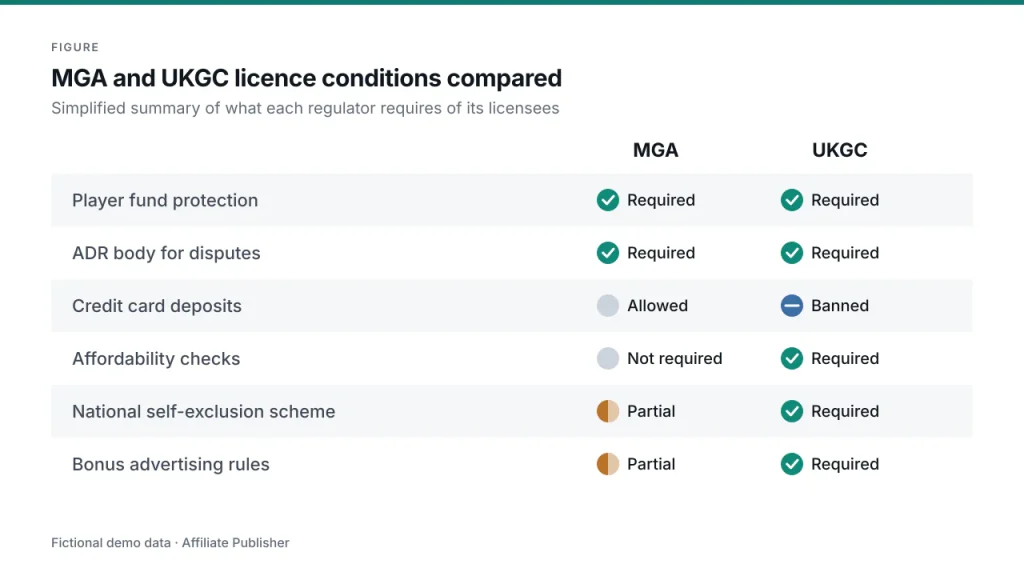
The headline is that both regulators require segregated player funds, independent certification of random number generators and a named alternative dispute resolution body. Where they differ is in how far they reach into the commercial side of the business. The EGC caps bonus wagering, bans certain promotional mechanics outright and requires affordability checks above set deposit thresholds. The EGA leaves bonus design largely to operators, provided the terms are clear, and requires affordability interventions only where there are indicators of harm.
Fund protection in practice
“Segregated funds” sounds reassuring, but there are degrees of protection. Under the EGC’s rules, operators must state on their site which of three protection levels (basic, medium or high) applies, and only the high level guarantees that player funds are held in a trust that survives the operator’s insolvency. Under the EGA’s rules, segregation is mandatory but the insolvency protection is less explicit.
In our reviews we record which level applies and quote the operator’s own statement. Of the operators we currently list, the EGC-licensed PrimeLuck and Solstice both state high-level protection; the EGA-licensed operators state segregation without a trust arrangement.
Complaints and dispute resolution
Both regimes require operators to offer a free, independent dispute route once internal complaints are exhausted. The practical difference is timescale and transparency. The EGC publishes the number of complaints escalated against each licensee and the proportion upheld; the EGA publishes aggregate figures only. For a player, the EGC figures are more useful because they let you compare operators directly.
In our complaints guide we describe how to use both routes. In short: complain in writing, keep every reply, and escalate only after the operator’s internal deadline has passed.
What about offshore licences?
Two of the operators on our list, VelvetPlay and ApexBet, hold licences from the Example Offshore Licensing Board. We do not treat this as a reason to exclude them, because both paid our withdrawals in full and both offer products that EU-licensed operators do not. But we do score them lower on safety, and we say why on each review: the licence requires neither segregated funds nor an independent dispute body, and its public register does not record sanctions.
If you play at an offshore-licensed operator, keep your balance low and withdraw regularly. The protections you are used to from a tighter regime may simply not exist.
Our verdict
Asked which licence is stricter, we would say the EGC. On bonuses, marketing and affordability it reaches further into the operator’s business, and its complaints data is more transparent. Asked which is better for players, the answer depends on what you value. The EGA’s lighter touch means a wider choice of operators and offers; the EGC’s heavier hand means fewer surprises.
Either is a solid foundation. The licence we would not call a foundation is the offshore tier, and the thing we would not do is take any operator’s word for which licence it holds. Check the register. We do, every 90 days.
Frequently asked questions
How do I check an operator’s licence?
Scroll to the footer of the operator’s site, find the licence number and look it up on the regulator’s public register. If the number is missing or does not match, treat that as a serious warning.
Can an operator hold both licences?
Yes, and many do. They typically serve players in different countries under each licence, and the terms you see depend on where you register from.
Are these real regulators?
No. The Example Gaming Authority, the Example Gambling Commission and the Example Offshore Licensing Board are fictional, as is every operator on this demo site.
Sources
- Example Gaming Authority licensee register (Example Gaming Authority)
- Licence conditions and codes of practice (2026 edition) (Example Gambling Commission)
Sources & references
Spotted an inaccuracy? Tell us — we publish corrections publicly.
About the author

Priya Nair
Priya oversees editorial standards and methodology, ensuring every review is independently researched and updated on a fixed cadence.