


Two numbers, two different questions
Every slot on this site shows two figures: an RTP and a volatility rating. They answer different questions. RTP (return to player) is the percentage of all money staked that the game returns to players over a very long run. A 96% RTP means that, across millions of spins, the game keeps 4%. It says nothing about any individual session. Volatility, sometimes called variance, describes how the returns are distributed: whether the game pays small amounts often or large amounts rarely.
Two slots with identical 96% RTP can feel completely different to play. One might return most of its 96% in frequent small wins that keep your balance hovering around where it started. The other might go a hundred spins without paying and then return a chunk in one bonus round. Over a long enough run they return the same. Over an evening, they do not.
What the curves look like
The chart below shows the balance over time for three of our logged test sessions, each of 500 spins at a fixed stake on a slot from our catalogue: Velvet Fortune (low volatility), Solar Rush (medium) and Glacier Gold (high). The sessions were chosen as typical of what we saw across repeated runs, not as the best or worst. All three games have an RTP within a point of each other.

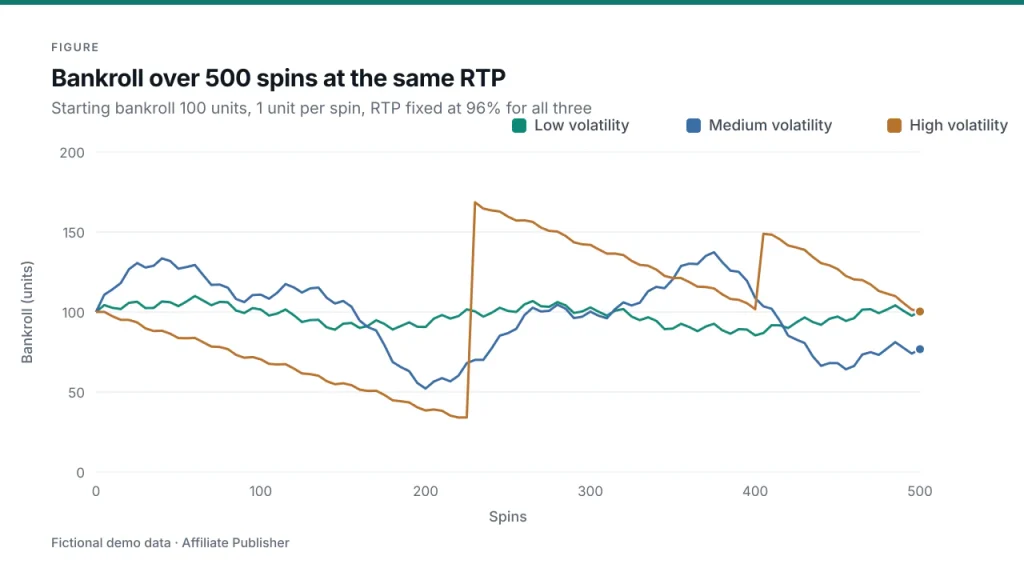
The low-volatility line drifts gently downward with small bumps — the game is paying often, but rarely more than a few times the stake, and the house edge shows as a slow decline. The medium line has more pronounced swings and a couple of recoveries from bonus rounds. The high-volatility line is the one people remember: a long decline through a dry spell, then a free spins round that put the balance well above its starting point, followed by another decline. In other runs of the same game, the free spins did not arrive within 500 spins and the session simply declined throughout.
What low volatility means in practice
A low-volatility slot (Velvet Fortune, Prime Sevens, Ember Reels in our catalogue) pays frequently and modestly. The maximum win is usually a few hundred times the stake. For a given budget, you get the most spins and the most time, and your balance rarely moves far in either direction. This is the right choice if you want a long session, if you are playing with a small budget, or if you are clearing a bonus and want to minimise the chance of busting before wagering is complete.
The trade-off is that a big win is unlikely. If the appeal of slots for you is the possibility of a large return from a small stake, a low-volatility game will feel flat.
What high volatility means in practice
A high-volatility slot (Glacier Gold, Midnight Vault, Meteor Megaways, Tundra Treasure) pays rarely and, when it does, can pay thousands of times the stake. In our logged sessions, the longest run without a win above the stake on a high-volatility game was over 120 spins. Balances fell faster and further than on any other category, and the single largest win in our entire test, on Tundra Treasure, came from a high-volatility game.
This is the right choice only if you have a budget that can absorb long losing runs, if you are prepared to end a session well down, and if you play for the possibility of a large win rather than the expectation of one. Bonus-buy features, which many high-volatility games offer, let you pay a large multiple of the stake to trigger the feature directly; they do not change the RTP, but they concentrate the volatility into a single expensive decision.
Medium volatility and the Megaways question
Most popular slots sit in the middle (Stellar Spins, Solar Rush, Altura Peaks, Northstar Reels), with moderate hit frequency and maximum wins in the low thousands of times the stake. They are the sensible default for most players and most budgets. Megaways and cascading-reel games are usually high volatility despite feeling busy: the constant cascades and the large number of ways to win create an impression of frequent action, but the balance curve in our tests behaved like a high-volatility game, with the real returns concentrated in the free spins round.
How we rate volatility
Providers publish a volatility rating for most games, and we start from that. We then log at least 1,000 spins per game across our test sessions and compare the observed hit frequency and the distribution of win sizes with the published rating. Where they disagree significantly, we say so in the game review and use our own observation. Across the catalogue on this site, the published ratings held up well; the one game we would rate differently is noted in its review.
Whatever volatility you choose, set a budget for the session before you start, decide in advance what a stop looks like, and treat the possibility of a big win as entertainment rather than a plan. Volatility describes the ride; it does not change the destination.
Frequently asked questions
Is high volatility better for winning big?
It makes a large single win more possible and a large loss more likely. The expected return is set by RTP, not volatility, and is below your stake on every slot.
Does volatility change with the stake?
No. The distribution of outcomes is the same at every stake. A higher stake only scales the swings.
Which volatility is best for clearing a bonus?
Low or medium, because they reduce the chance of losing the bonus balance before wagering is complete. Check that the game contributes 100% first.
Sources
- Polar Play game information sheets (Polar Play (fictional))
- NovaSoft RTP and volatility disclosures (NovaSoft (fictional))
Sources & references
-
Original documentation
Spotted an inaccuracy? Tell us — we publish corrections publicly.
About the author


Sofia Marchetti
Sofia plays every game we rate on at least two devices, logs session results against published RTP and volatility, and benchmarks live dealer studios for latency and dealer quality.