





Why we publish our method
A rating is only useful if you know how it was produced. Most casino comparison sites publish a number and a star graphic; very few publish the checklist behind it. We think that is backwards. If our readers cannot see how we arrived at a score, they have no way of deciding whether to trust it, and no way of telling us when we have got something wrong.
This page describes the process every operator on this site goes through before a rating appears. It is deliberately repetitive. The point of a fixed method is that no editor can shortcut a review, and that a review written in 2024 remains comparable with one written in 2026. Where the method has changed, we say so in the corrections log for the affected reviews.
The six categories and how they are weighted
We score every operator across six categories: safety, bonuses, payments, games, support and mobile. Each category is scored out of ten against a written checklist, and the overall rating is a weighted average. Safety and payments carry the heaviest weight because, in our experience, they are the two areas where a poor operator does the most harm to a player. Games and mobile carry the lightest weight, not because they do not matter, but because a thin catalogue is an inconvenience whereas a withheld withdrawal is a loss.
In brief, the six categories cover the following.
- Safety: licensing, clarity of terms, responsible gambling tools and how verification is handled.
- Bonuses: the full terms rather than the headline: wagering multiples, contribution weights, maximum bet rules and expiry windows.
- Payments: range of methods, fees, limits and, above all, how long withdrawals actually take.
- Games: catalogue breadth, provider mix and whether RTP figures are shown in-game.
- Support: response time and the quality of the answer, tested at two different hours.
- Mobile: the app or web experience on both major platforms, including an older mid-range handset.
The six-week testing window
Each operator is tested over a six-week window by at least two members of the team, using accounts opened in our own names and funded with our own money. We do not accept test accounts, bonus-free accounts or any other arrangement from an operator, because those accounts are not the ones a reader will be using. The timeline below shows how a typical review is spread across those six weeks.

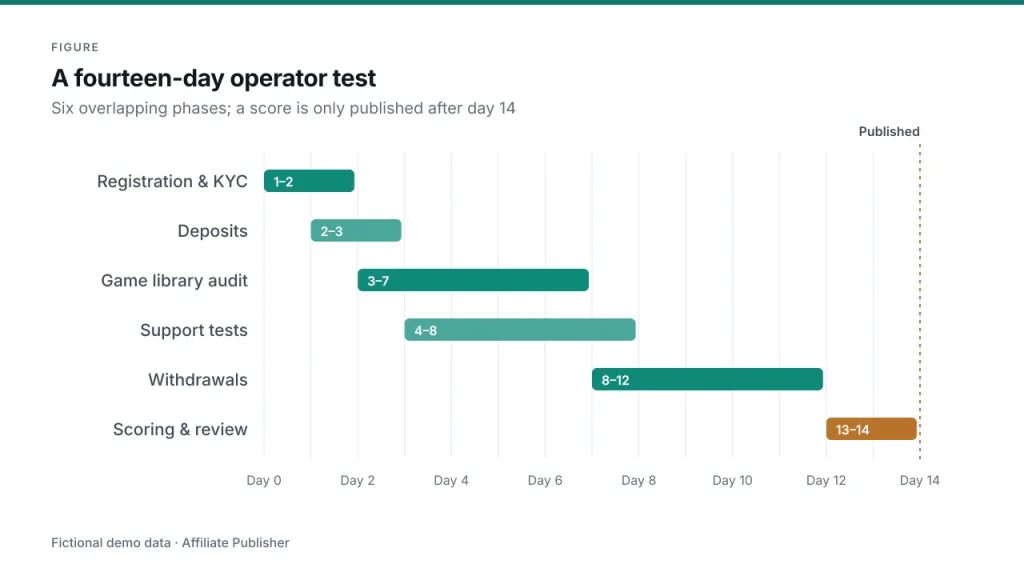
Week one is registration and verification. We note what documents are requested, how long verification takes and whether we were asked for anything unusual. Weeks two and three cover deposits and play across each vertical the operator offers. Weeks four and five are withdrawals — at least three, by different methods, timed from the moment we click confirm to the moment funds are visible. Week six is support testing and a second editor’s review of the evidence. Nothing in the timeline is skipped to meet a publishing date; if a withdrawal is still pending, the review waits.
What we measure rather than read
The distinction between measured and read is central to how we work. An operator’s website may say “withdrawals in 24 hours”. We treat that as a claim to be tested, not a fact to be repeated. The same applies to support availability, game counts and licence status. Where a figure on this site is one we measured, the review says so and shows the evidence block with the dates, the method and the amount. Where a figure comes from a document, such as a licence register, a terms page or a regulator’s notice, the review cites that document and the date we retrieved it.
In our October 2026 round, the gap between advertised and measured withdrawal times ranged from a few minutes to just under two days across the operators we tested. That spread is exactly why we insist on measuring. A reader comparing two operators by their marketing copy would have seen almost no difference between them.
Who scores, and who checks the scorer
Every review has a named author and a named second reviewer. The author runs the tests and drafts the scores; the second reviewer checks each score against the evidence and can send it back. A third editor signs off on sources before publication. None of the three can see commission data for the operator while this is happening; the commercial team works from a separate system and is not involved in scoring.
This is not a guarantee that we never make mistakes. It is a guarantee that a mistake has to get past three people, and that when one does, the corrections log on the affected page will say what changed, when and why.
Scores are produced before any commercial relationship is considered. The commercial team works from a separate system and has no access to draft reviews. See our affiliate disclosure for how links on this site work.
Re-testing and the 90-day rule
Operators change. A licence can lapse, a bonus structure can be rewritten overnight and a payments provider can be replaced without notice. Every operator on this site is re-audited at least once every 90 days. We also re-test immediately after any material change we become aware of: a new licence, a regulator sanction, a change to withdrawal terms or a pattern of reader complaints we can verify independently.
A re-test is a shorter version of the full audit, typically a fresh withdrawal by each method, a support contact and a terms comparison. The date of the most recent re-test is shown at the top of every review. If that date is more than 90 days old, the review is flagged as due for refresh and the rating is shown with a warning until the re-test is complete.
How to tell us we are wrong
We welcome corrections. Every review links to a correction form, and every correction we accept is published on the page it affects with the date and a short note on what changed. If you believe a score is wrong, the most useful thing you can send us is evidence: screenshots with timestamps, the terms page as it appeared to you, or the regulator notice we missed. We cannot act on anonymous claims about an operator’s conduct, but we can and do re-test when a reader points us to something we can verify ourselves.
Frequently asked questions
Do operators pay to be reviewed?
No. We choose which operators to review, and no operator can pay for a review, a score or a position in a list. Some links are affiliate links; see our affiliate disclosure for how that works.
Can an operator see its review before it is published?
No. Operators are notified when a review goes live and can use the same correction process as any reader.
Why do some reviews show a “due for refresh” warning?
Because the last full re-test is more than 90 days old. The rating stands, but we flag it so you know the evidence is ageing.
Sources
- Review methodology (full checklist) (WagerThemes demo site)
- Licence conditions and codes of practice (2026 edition) (Example Gambling Commission)
Spotted an inaccuracy? Tell us — we publish corrections publicly.
About the author


Priya Nair
Priya oversees editorial standards and methodology, ensuring every review is independently researched and updated on a fixed cadence.